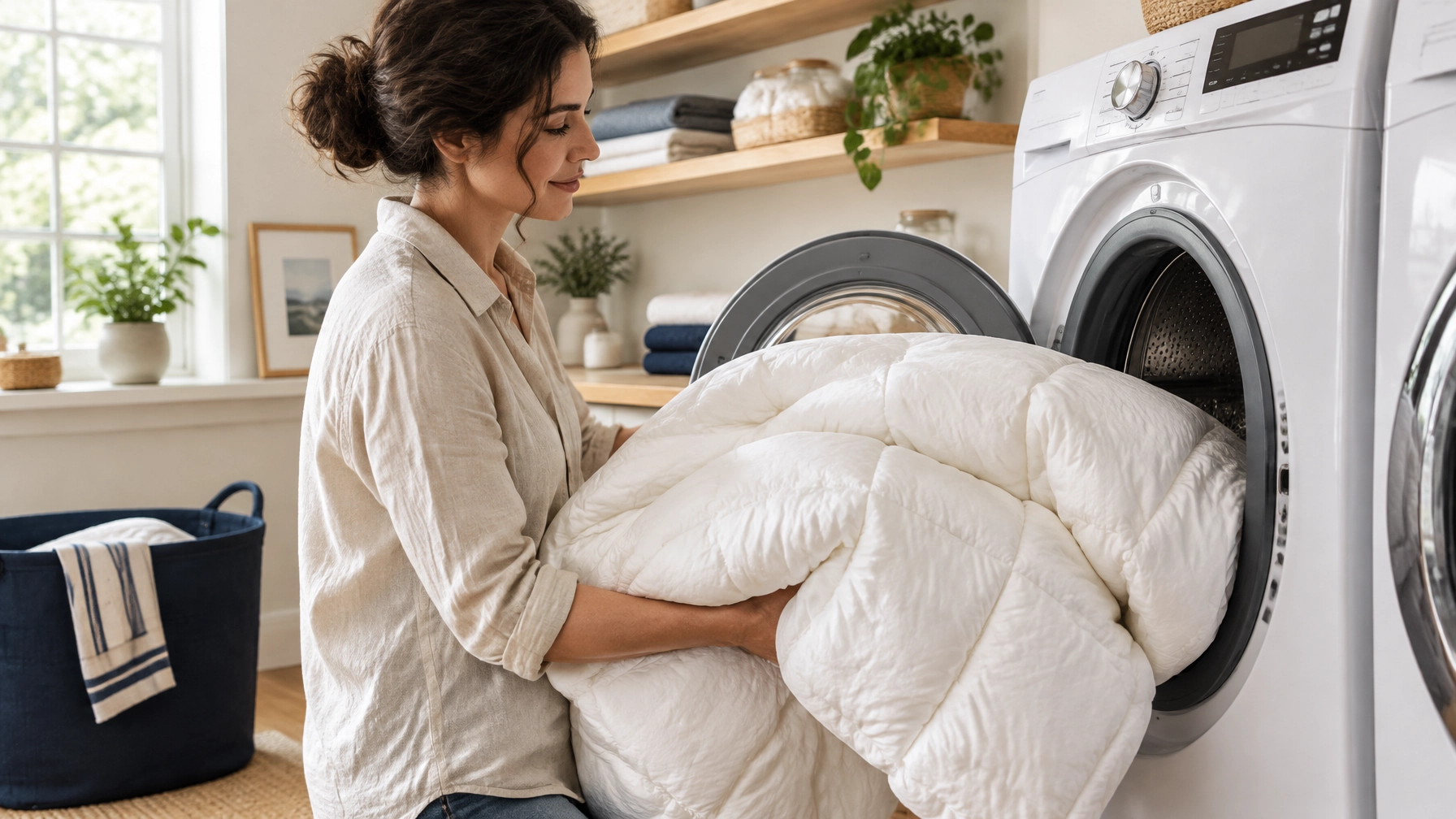
Washing a comforter at home can be straightforward when the care label, washer and dryer are up to the job. The part that tends to take patience is drying: bulky filling can hold moisture and form clumps if you rush it.
This guide walks you through how to wash a comforter safely, what common mistakes to avoid, and when it may make more sense to hand the job off.
Before you wash, check these three things
Read the care label. It’s the best guide to whether the comforter can go in a washing machine and what water temperature and drying method to use. If the label says “dry clean only,” don’t machine-wash it. Rivers & Fold also does not accept dry-clean-only items.
Check the washer’s capacity. The comforter needs enough room to move freely in the drum. If it’s packed in tightly, water and detergent may not circulate or rinse through the filling properly. A large-capacity front-loader is often the practical choice for comforters larger than twin size. A top-loader with a central agitator can twist or tear the fabric and disturb the filling.
Check the dryer, too. The comforter needs room to tumble. If it has to be crammed into the dryer, it may not dry evenly. A larger dryer, such as one at a laundromat, may be necessary.

How to wash a comforter at home
-
Prepare the comforter. Remove the duvet cover, if there is one, and check the comforter for loose seams or tears. Take off any removable parts that the care label says not to wash.
-
Pre-treat visible stains. Use a stain treatment that’s suitable for the fabric and follow its directions. Dab or gently work on the affected area rather than scrubbing hard, which can damage fabric or push a stain deeper.
-
Load the washer without forcing it. Wash the comforter by itself. It should sit loosely enough to tumble. If you have to push it into the drum or can barely close the door, use a larger machine instead.
-
Choose a gentle wash. Select a gentle, delicate or bedding cycle, depending on what your machine offers and what the care label allows. Use cold or warm water as directed on the label, along with a small amount of mild detergent. When washing down, avoid bleach and fabric softener, and don’t use hot water unless the label specifically instructs you to. Hot water can strip natural oils from down.
-
Add an extra rinse. Comforter filling can trap detergent. An additional rinse helps clear away residue that might otherwise irritate sensitive skin or leave the fabric feeling coated. For more guidance on the wash cycle and rinse, see Martha Stewart’s comforter-washing guide and Wirecutter’s guide to washing a comforter.
-
Check the comforter before drying. Make sure it isn’t dripping wet. If your washer allows it and the care label permits, an additional spin can remove more water before the comforter goes into the dryer.
Whether you’re searching for how to wash comforter in washing machine or just trying to get through laundry day safely, the same rule applies: follow the care label and don’t crowd the machine.

Dry it slowly and check for clumps
Set the dryer to low heat, or follow the care label if it gives different instructions. Add dryer balls or clean tennis balls to help move the filling around as the comforter tumbles.
Pause every 20 to 30 minutes. Take the comforter out, shake it gently and break apart any clumps you can feel. Turn it and redistribute the filling before putting it back in the dryer. This takes extra time, but helps the comforter dry more evenly.
Don’t rely on the outside feeling dry. Check the middle, seams and corners for cool or damp spots. The comforter must be completely dry before it goes back on the bed or into storage. Damp filling can develop a musty smell and may encourage mold or mildew.

Common mistakes to avoid
- Overloading the washer: A crowded comforter may not wash or rinse evenly.
- Using an agitator washer: A central agitator can pull at the fabric and filling.
- Using bleach or fabric softener on down: These can harm the filling. Follow the care label for any comforter type.
- Using hot water on down: Heat can strip natural oils from the down.
- Skipping the extra rinse: Leftover detergent may irritate skin or leave residue.
- Assuming one dryer cycle is enough: The filling may still be damp inside.
- Cramming it into a small dryer: Restricted movement can leave wet patches and clumps.
If a wash doesn’t go well, you might notice flattened or clumped filling, a musty smell from incomplete drying, a tear from an agitator, or detergent residue that bothers sensitive skin. Checking capacity and care instructions before you begin can help prevent these problems.
When home washing isn’t realistic
Sometimes the practical answer is a larger machine. If your comforter cannot tumble freely in your washer or dryer, don’t force it. Many households need to make a trip to a laundromat to use a large-capacity machine. That’s a reasonable option, but it adds travel and more time to the task.
A “dry clean only” label is another clear stopping point. Don’t machine-wash the item, and keep in mind Rivers & Fold does not accept dry-clean-only items. And if a wash, rinse and several hours of drying simply aren’t a project you want to take on, handing it off is a practical alternative.
A simpler option for machine-washable bedding
Rivers & Fold accepts machine-washable comforters, quilts and blankets alongside household laundry. Comforters are priced individually by size, from $18 to $25; other standard laundry is $2.50 per pound, with a $37.50 minimum. Pickup and delivery are complimentary. You don’t weigh anything at home: we weigh your laundry after pickup and send you the total for approval before washing. After approval and payment, items are returned within 24–48 hours; weekend pickups roll over to the next business day.
Choose from four detergent options, including fragrance-free choices for sensitive skin. Stain treatment is available on request, and pet-friendly households are welcome. If you’d like us to handle the comforter, request a pickup.
FAQ
Can I wash a comforter in a regular washing machine?
Sometimes. Check the care label and make sure the comforter has room to tumble freely. If it’s larger than twin size or crowds your washer, use a larger-capacity machine instead.
How do I dry a comforter without clumps?
Dry it on low heat with dryer balls or clean tennis balls. Every 20 to 30 minutes, take it out, shake it and break up any clumps so the filling can redistribute.
How long does it take to dry a comforter?
It varies with the comforter’s size and filling, your dryer and how much water remains after washing. Plan to check and fluff it regularly, and keep drying until the middle and corners are completely dry. One cycle may not be enough.
What if my machine is too small?
Don’t force the comforter into a crowded washer or dryer. Use a larger-capacity machine, such as one at a laundromat, or hand off the job if the comforter is machine-washable.
Does Rivers & Fold take comforters?
Yes, if they’re machine-washable and suitable for the laundry process. Comforters are priced individually by size. We do not accept dry-clean-only items.
Less laundry. More life.
Leave a Reply